I. WHY WAS IT
NECESSARY TO "INVENT" GOD?
[An oven] that was cut into parts and sand was placed between the parts, Rabbi Eliezer maintained that it is pure (i.e., not susceptible to ritual impurity). The other sages said that it is susceptible to ritual impurity....
On that day, Rabbi Eliezer brought them all sorts of proofs, but they were rejected. Said he to them: "If the law is as I say, may the carob tree prove it." The carob tree was uprooted from its place a distance of 100 cubits. Others say, 400 cubits. Said they to him: "One cannot prove anything from a carob tree."
Said [Rabbi Eliezer] to them: "If the law is as I say, may the aqueduct prove it." The water in the aqueduct began to flow backwards. Saidthey to him: "One cannot prove anything from an aqueduct."
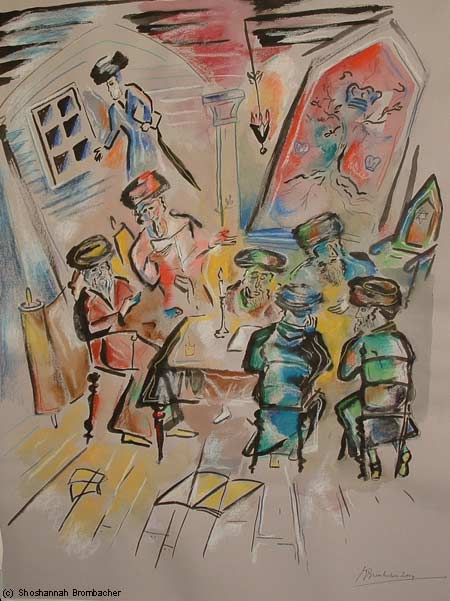
Said he to them: "If the law is as I say, then may the walls of the house of study prove it." The walls of the house of study began to cave in. Rabbi Joshua rebuked them, "If Torah scholars are debating a point of Jewish law, what are your qualifications to intervene?" The walls did not fall, in deference to Rabbi Joshua, nor did they straighten up, in deference to Rabbi Eliezer. They still stand there at a slant.
Said he said to them: "If the law is as I say, may it be proven from heaven!" There then issued a heavenly voice which proclaimed: "What do you want of Rabbi Eliezer -- the law is as he says..."
Rabbi Joshua stood on his feet and said: "'The Torah is not in heaven!'1" ... We take no notice of heavenly voices, since You, G-d, have already, at Sinai, written in the Torah to "follow the majority."2
Rabbi Nathan subsequently met Elijah the Prophet and asked him: "What did G-d do at that moment?" [Elijah] replied: "He smiled and said: 'My children have triumphed over Me, My children have triumphed over Me.'"
| FOOTNOTES | |
| 1. | Deuteronomy 30:12. |
| 2. | Exodus 23:2. |
- Talmud, Baba
Metzia 59ab
Question #1 : Is Man essentially a "civilized" species which has been endowed with built-in controls against self-annihilation, or, at least, against self-destruction?
Evidence (Con):
A) Unlike even the Wolf (regarded by man as one of the most
savage of critters), Man has NO intrinsic inhibitions against
murdering [often brutally so] members of his own species. B)
Inquisition. C) Holocaust. D) Hiroshima. E) Nagasaki F) World
Trade Center/Pentagon Massacre G) ad finitum
Question #2 : Could "God" perhaps represent the historical development of an over-riding Conscience, i.e., a governing sense of Right and Wrong, Good and Evil, which might mitigate Man's inherent lack of self-control?
Evidence (Pro):
A) The Laws of Moses B) Jesus Christ C) Buddha
Question #3
: Is there any selective advantage to the concept of
"One God"?
Evidence (Pro):
A)Man, as a social animal, developed into groups of varying sizes
and strengths. Each small group had its own individual set of
signs, symbols, habits, gestures, languages, and mores. The most
common means of perpetuation of any of these identifying elements
was by aggrandizement, i.e., by conquest and imposition. There
was no sure way of one group "understanding the ways"
of another, unless by surrendering its own and adopting the
other's, or by conquering the other and establishing its own
hegemony. One set of "rules" or "laws' which apply
equally to all tribes, might certainly allow for some protracted
periods of peaceful coexistence. B)Contrast the moral imperatives
of polytheistic deities versus the "concensus" deity of
Judaism, Christianity, and Islaam.
Evidence (Con) : A) Even the attempt to establish "One God" has failed to inhibit the plethora of interpretations which has continually undermined any sense of religiously based common law. B) Possibly many more people have died for the sake of "One God" (religion) and because of it, than have been spared since its inception? C) Is not the "infidel" always devoid of the protection of God's grace?
Question #4a : Is there any selective advantage to not being an atherist?
Evidence (Con) : If all of us were always atheists, what then?
If
inference and reason shun
Hell, Heaven, and Oblivion,
May thwarted will (perforce precarious,
But for our conservation better thus)
Have no misgiving left
Of doing yet what here we leave undone?
-The Man Against
the Sky, E.A.Robinson
Question #4b
: What else besides a controversial conscience does the
concept of God do for man?
Evidence :
Life
is but a walking shadow,
A poor player that struts and frets his hour
Upon the stage and then is heard no more.
It is a tale told by an idiot,
Full of sound and fury,
Signifying nothing.
-Macbeth,William Shakespeare
Evidence : ...He may have
proved a world a sorry thing,
In his imagining,
And life a lighted highway to the tomb....
For
nothing but the sake of being caught
And sent again to nothing will attune
Itself to any key of reason
Why man should hunger through another season....
Why pay
we such a price, and one we give
So clamoringly,for each racked empty day
That leads one more last human hope away,
As quiet fiends would lead past our
crazed eyes
Our children to an unseen sacrifice?
If all
that we have lived and thought,
All comes to Nought,-
If there be nothing after Now,
And we be nothing anyhow,
And we know that, -why live?
-"The Man Against the Sky", E.A.Robinson
Question #5
: Is it possible that Man, the savage killer, alone, and
afraid in a world which made no sense, was in need of direction,
hope, support, understanding, in short, that he was in dire need
of a friend?
There
is no creature the Holy One, blessed be He, rejects, but he
accepts
them all. The gates are open at every hour, and all who wish to
enter, may enter. Therefore it is said:-
"My doors I opened to the wanderer"
(Job 31:32)
- meaning the Holy One, blessed be He,
who suffers his creatures.
-A Midrash (The Gates:Exod.Rabbah XIX.4)
It is said (Ma'ase Avraham
32-34; Sepher Hayashar 34-43) that the angel Gabriel picked the
young boy Abram upon his shoulders and quickly transported him
across time and space from Ur in Chaldea unto Babel, where the
young fellow met Noah and followed him as his student. Growing
fuller of wisdom, Abram returned to Babel to find his father
Terah, the General of Nimrod's armies, worshiping idols of wood
and stone - apparently twelve superior ones among many inferiors.
He then
asked his mother, Amitlai, to sacrifice and prepare a lamb which
he offered to the idols. Observing their apparent lack of
interest in this perhaps too meager offering, he again asked his
mother to prepare for their greater glory three more little lambs
with even greater seasoning.
Observing the total ennui
and inertia of these presumed "gods", Abram was
suddenly moved by the Spirit of God. He proceded, axe in hand, to
annihilate the idols, sparing only the largest, in whose hands he
placed the lethal weapon.
Hearing the tumult, Terah's curiosity eventually got the better
of him and he came out of his chambers to investigate. Seeing the
goetterdaemmerung, he called for Abram and demanded of him,
"What is this!?"
Abrams response was, "I made an offering of peace to your gods. Obviously there was a great difference of opinion and the most powerful hacked all of the others to pieces."
When Terah answered that
the idols were only of wood and stone, fashioned by man, Abram
asked him, "Then why is it you daily offer them food which
they cannot eat or prayers which they cannot answer?"
Preaching to his father about the Flood as the punishment of the
only Living God for the inherent wickedness of man, Abram picked
up the axe and hacked the last remaining idol to bits.
Question[s] #6:
Did the concept of God then initially represent the triumph
of the subjective modality of the potentially invincible
invisible over the objective modality of the apparently
susceptible perceptible? [Is this why miracles are necessary?] Or
is this question precisely the one that prompted the authors [or
editors] of Genesis, Ezra, or Jeremiah to leave this tale [of
Abraham] as Midrash rather than incorporate it into Scripture?
Might it also be, perhaps, that the human spirit was humbly
beginning to realize the limits of its intelligence - that there
could be many questions which lay far beyond the capability of
human understanding?
Evidence:-
My
religion consists of a humble admiration
of the illimitable superior spirit who reveals
himself in the slight details we are able to
perceive with our frail and feeble minds.
-Albert Einstein
Why is it necessary to
impose our obviously limited perspective upon the infinite or
incomprehensible and, worse, to demand some consensus therefrom?
Or should we grudgingly confine ourselves to trying to discern
what has been called in modern [particularly Catholic] theology -
"the
human face of God", i.e, those aspects of the Almighty
which might be both relevant and simple to the human psyche? In
this sense alone might not the trinitarian concept of Jesus [as a
part of God] become even minutely acceptable to the Jewish
spirit?
Country Bumpkin
(Hick) #1:-"There ain't no God!"
Country Bumpkin (Hick) #2:-"Oh,
yeah? Then jest what is it that ain't?"


